
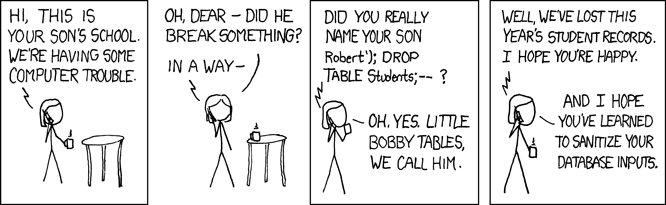
(from https://xkcd.com/327/)
SQL injection example
Setup and sample run
  # Use a simple headline prompt
  PS1='
  \033[32m---- SQL injection demo ----\[\033[33m\033[0m\]
  $?:$ '


  # Build
  ./build.sh

  # Prepare db
  ./admin -r
  ./admin -c
  ./admin -s

  # Add regular user interactively
  ./add-user 2>> users.log
  First User


  # Regular user via "external" process
  echo "User Outside" | ./add-user 2>> users.log

  # Check
  ./admin -s

  # Add Johnny Droptable
  ./add-user 2>> users.log
  Johnny'); DROP TABLE users; --

  # And the problem:
  ./admin -s

  # Check the log
  tail users.log
Identify the problem
./add-user is reading from STDIN, and writing to a database; looking at the code in
./add-user.c leads to
count = read(STDIN_FILENO, buf, BUFSIZE - 1);
for the read and
rc = sqlite3_exec(db, query, NULL, 0, &zErrMsg);
for the write.
This problem is thus a dataflow problem; in codeql terminology we have
- a source at the
read(STDIN_FILENO, buf, BUFSIZE - 1); - a sink at the
sqlite3_exec(db, query, NULL, 0, &zErrMsg);
We write codeql to identify these two, and then connect them via
- a dataflow configuration – for this problem, the more general taintflow configuration.
Build codeql database
To get started, build the codeql database (adjust paths to your setup):
  # Build the db with source commit id.
  # export PATH=$HOME/local/vmsync/codeql250:"$PATH"
  SRCDIR=$(pwd)
  DB=$SRCDIR/cpp-sqli-$(cd $SRCDIR && git rev-parse --short HEAD)

  echo $DB
  test -d "$DB" && rm -fR "$DB"
  mkdir -p "$DB"

  cd $SRCDIR && codeql database create --language=cpp -s . -j 8 -v $DB --command='./build.sh'
Then add this database directory to your VS Code DATABASES tab.
Build codeql database in steps
For larger projects, using a single command to build everything is costly when any part of the build fails.
To build a database in steps, use the following sequence, adjusting paths to your setup:
  # Build the db with source commit id.
  export PATH=$HOME/local/vmsync/codeql250:"$PATH"
  SRCDIR=$HOME/local/codeql-training-material.cpp-sqli/cpp/codeql-dataflow-sql-injection
  DB=$SRCDIR/cpp-sqli-$(cd $SRCDIR && git rev-parse --short HEAD)

  # Check paths
  echo $DB
  echo $SRCDIR

  # Prepare db directory
  test -d "$DB" && rm -fR "$DB"
  mkdir -p "$DB"

  # Run the build
  cd $SRCDIR
  codeql database init --language=cpp -s . -v $DB
  # Repeat trace-command as needed to cover all targets
  codeql database trace-command -v $DB -- make
  codeql database finalize -j4 $DB
Then add this database directory to your VS Code DATABASES tab.
Develop the query bottom-up
-
Identify the source part of the
read(STDIN_FILENO, buf, BUFSIZE - 1);
expression, the
bufargument. Start from afrom..where..select, then convert to a predicate. -
Identify the sink part of the
sqlite3_exec(db, query, NULL, 0, &zErrMsg);
expression, the
queryargument. Again start fromfrom..where..select, then convert to a predicate. -
Fill in the taintflow configuration boilerplate
  class CppSqli extends TaintTracking::Configuration {
      CppSqli() { this = "CppSqli" }

      override predicate isSource(DataFlow::Node node) {
          none()
              }

      override predicate isSink(DataFlow::Node node) {
          none()
              }
  }
Note that an inout-argument in C/C++ (the
bufpointer is passed toreadand points to updated data after the return) is accessed as a codeql source viasource.(DataFlow::PostUpdateNode).getPreUpdateNode().asExpr()
instead of the usual
source.asExpr()
The final query (without isAdditionalTaintStep) is
  /**
   ,* @name SQLI Vulnerability
   ,* @description Using untrusted strings in a sql query allows sql injection attacks.
   ,* @kind path-problem
   ,* @id cpp/SQLIVulnerable
   ,* @problem.severity warning
   ,*/

  import cpp
  import semmle.code.cpp.dataflow.TaintTracking
  import DataFlow::PathGraph

  class SqliFlowConfig extends TaintTracking::Configuration {
      SqliFlowConfig() { this = "SqliFlow" }

      override predicate isSource(DataFlow::Node source) {
          // count = read(STDIN_FILENO, buf, BUFSIZE);
          exists(FunctionCall read |
              read.getTarget().getName() = "read" and
              read.getArgument(1) = source.(DataFlow::PostUpdateNode).getPreUpdateNode().asExpr()
          )
      }

      override predicate isSink(DataFlow::Node sink) {
          // rc = sqlite3_exec(db, query, NULL, 0, &zErrMsg);
          exists(FunctionCall exec |
              exec.getTarget().getName() = "sqlite3_exec" and
              exec.getArgument(1) = sink.asExpr()
          )
      }
  }

  from SqliFlowConfig conf, DataFlow::PathNode source, DataFlow::PathNode sink
  where conf.hasFlowPath(source, sink)
  select sink, source, sink, "Possible SQL injection"
Optional: sarif file review of the results
Query results are available in several output formats using the cli. The following produces the sarif format, a json-based result description.
  # The setup information from before
  export PATH=$HOME/local/vmsync/codeql250:"$PATH"
  SRCDIR=$HOME/local/codeql-training-material.cpp-sqli/cpp/codeql-dataflow-sql-injection
  DB=$SRCDIR/cpp-sqli-$(cd $SRCDIR && git rev-parse --short HEAD)

  # Check paths
  echo $DB
  echo $SRCDIR

  # To see the help
  codeql database analyze -h

  # Run a query
  codeql database analyze                         \
         -v                                       \
         --ram=14000                              \
         -j12                                     \
         --rerun                                  \
         --search-path ~/local/vmsync/ql          \
         --format=sarif-latest                    \
         --output cpp-sqli.sarif                  \
         --                                       \
         $DB                                      \
         $SRCDIR/SqlInjection.ql

  # Examine the file in an editor
  edit cpp-sqli.sarif
An example of using the sarif data is in the the jq script ./sarif-summary.jq. When run against the sarif input via
jq --raw-output --join-output -f sarif-summary.jq < cpp-sqli.sarif > cpp-sqli.txtit produces output in a form close to that of compiler error messages:
  query-id: message line
      Path
         ...
      Path
         ...