# Table of Contents
1. [End-to-end demo of CodeQL command line usage](#orgbec345e)
1. [Run analyses](#org120a28d)
1. [Get collection of databases (already handy)](#org10f5d2f)
1. [Get https://github.com/hohn/codeql-workshop-vulnerable-linux-driver](#org3098062)
2. [Quick check using VS Code](#orga84eb1e)
3. [Install codeql](#org6e8bf77)
4. [Install pack dependencies](#orgefc5f79)
2. [Run queries](#org38093b3)
1. [Individual: 1 database -> N sarif files](#org5dc500d)
2. [Use directory of queries: 1 database -> 1 sarif file (least effort)](#org696d4ba)
3. [Use suite: 1 database -> 1 sarif file (more flexible, more effort)](#org5f683b3)
3. [The importance of versioning](#org3172fe1)
1. [CodeQL cli version](#orgc022fc5)
2. [Database version](#org1b0ed6d)
3. [Query set version](#org1a6cfa6)
2. [Review results](#orgebc1392)
1. [SARIF Documentation](#orgd483425)
2. [SARIF viewer plugin](#org1dd7344)
1. [Install plugin in VS Code](#org41d6b5c)
2. [Review](#orgc0d3ad4)
3. [View raw sarif with `jq`](#orgeb5a147)
4. [View raw sarif with `jq` and fzf](#orga406a9a)
5. [sarif-cli](#org08832bc)
1. [Setup / local install](#org49abefb)
2. [Compiler-style textual output from SARIF](#org4e881d5)
3. [SQL conversion – not compatible with codeql v2.13.4](#org3c1536b)
3. [Running sequence](#orgcc12fc2)
1. [Smallest query suite to largest](#org267aec6)
2. [Working with results based on counts](#org9a3230f)
4. [Comparing analysis results across sarif files](#org60393a3)
5. [Miscellany](#orgbec3025)
# End-to-end demo of CodeQL command line usage
## Run analyses
### Get collection of databases (already handy)
#### Get
cd ~/local
git clone git@github.com:hohn/codeql-workshop-vulnerable-linux-driver.git
cd codeql-workshop-vulnerable-linux-driver/
unzip vulnerable-linux-driver.zip
tree -L 2 vulnerable-linux-driver-db/
vulnerable-linux-driver-db/
├── codeql-database.yml
├── db-cpp
│ ├── default
│ ├── semmlecode.cpp.dbscheme
│ └── semmlecode.cpp.dbscheme.stats
└── src.zip
3 directories, 4 files
#### Quick check using VS Code
The same steps will repeat for the cli.
- select DB
- select query
- run query
- view results
#### Install codeql
1. Full docs
-
-
2. In short:
cd ~/local/codeql-cli-end-to-end
# Decide on version / os via browser, then:
wget https://github.com/github/codeql-action/releases/download/codeql-bundle-v2.13.4/codeql-bundle-osx64.tar.gz
# Fix attributes on mac
if [ `uname` = Darwin ] ; then
xattr -c *.tar.gz
fi
# Extract
tar zxf ./codeql-bundle-osx64.tar.gz
# Check binary
pwd
# /Users/hohn/local/codeql-cli-end-to-end
./codeql/codeql --version
# CodeQL command-line toolchain release 2.13.4.
# Copyright (C) 2019-2023 GitHub, Inc.
# Unpacked in: /Users/hohn/local/codeql-cli-end-to-end/codeql
# Analysis results depend critically on separately distributed query and
# extractor modules. To list modules that are visible to the toolchain,
# use 'codeql resolve qlpacks' and 'codeql resolve languages'.
# Check packs
0:$ ./codeql/codeql resolve qlpacks |head -5
# codeql/cpp-all (/Users/hohn/local/codeql-cli-end-to-end/codeql/qlpacks/codeql/cpp-all/0.7.3)
# codeql/cpp-examples (/Users/hohn/local/codeql-cli-end-to-end/codeql/qlpacks/codeql/cpp-examples/0.0.0)
# codeql/cpp-queries (/Users/hohn/local/codeql-cli-end-to-end/codeql/qlpacks/codeql/cpp-queries/0.6.3)
# codeql/csharp-all (/Users/hohn/local/codeql-cli-end-to-end/codeql/qlpacks/codeql/csharp-all/0.6.3)
# codeql/csharp-examples (/Users/hohn/local/codeql-cli-end-to-end/codeql/qlpacks/codeql/csharp-examples/0.0.0)
# Fix the path
export PATH=$(pwd -P)/codeql:"$PATH"
# Check languages
codeql resolve languages | head -5
# go (/Users/hohn/local/codeql-cli-end-to-end/codeql/go)
# python (/Users/hohn/local/codeql-cli-end-to-end/codeql/python)
# java (/Users/hohn/local/codeql-cli-end-to-end/codeql/java)
# html (/Users/hohn/local/codeql-cli-end-to-end/codeql/html)
# xml (/Users/hohn/local/codeql-cli-end-to-end/codeql/xml)
3. A more fancy version
# Reference urls:
# https://github.com/github/codeql-cli-binaries/releases/download/v2.8.0/codeql-linux64.zip
# https://github.com/github/codeql/archive/refs/tags/codeql-cli/v2.8.0.zip
#
# grab -- retrieve and extract codeql cli and library
# Usage: grab version url prefix
grab() {
version=$1; shift
platform=$1; shift
prefix=$1; shift
mkdir -p $prefix/codeql-$version &&
cd $prefix/codeql-$version || return
# Get cli
wget "https://github.com/github/codeql-cli-binaries/releases/download/$version/codeql-$platform.zip"
# Get lib
wget "https://github.com/github/codeql/archive/refs/tags/codeql-cli/$version.zip"
# Fix attributes
if [ `uname` = Darwin ] ; then
xattr -c *.zip
fi
# Extract
unzip -q codeql-$platform.zip
unzip -q $version.zip
# Rename library directory for VS Code
mv codeql-codeql-cli-$version/ ql
# remove archives?
# rm codeql-$platform.zip
# rm $version.zip
}
grab v2.7.6 osx64 $HOME/local
grab v2.8.3 osx64 $HOME/local
grab v2.8.4 osx64 $HOME/local
grab v2.6.3 linux64 /opt
grab v2.6.3 osx64 $HOME/local
grab v2.4.6 osx64 $HOME/local
4. Most flexible in use, but more initial setup
`gh`, the GitHub command-line tool from
- gh api repos/{owner}/{repo}/releases
- gh extension create
- gh codeql extension
- gh gist list
0:$ gh codeql
GitHub command-line wrapper for the CodeQL CLI.
#### Install pack dependencies
1. Full docs
-
-
2. View installed docs via `-h` flag, highly recommended
# Overview
codeql -h
# Sub 1
codeql pack -h
# Sub 2
codeql pack install -h
3. In short
1. Create the qlpack
Create the qlpack files if not there, one per directory. In this project,
that's already done:
0:$ find codeql-workshop-vulnerable-linux-driver -name "qlpack.yml"
codeql-workshop-vulnerable-linux-driver/queries/qlpack.yml
codeql-workshop-vulnerable-linux-driver/solutions/qlpack.yml
codeql-workshop-vulnerable-linux-driver/common/qlpack.yml
For example:
cat codeql-workshop-vulnerable-linux-driver/queries/qlpack.yml
shows
---
library: false
name: queries
version: 0.0.1
dependencies:
codeql/cpp-all: ^0.7.0
common: "*"
So the queries directory does not contain a library, but it depends on one,
cat codeql-workshop-vulnerable-linux-driver/common/qlpack.yml
---
library: true
name: common
version: 0.0.1
dependencies:
codeql/cpp-all: 0.7.0
2. Install each pack's dependencies
The first time you install dependencies, it's a good idea to do this
menually, per `qlpack.yml` file, and deal with any errors that may occur.
pushd ~/local/codeql-cli-end-to-end/codeql-workshop-vulnerable-linux-driver
codeql pack install --no-strict-mode queries/
After the initial setup and for automation, install each pack's
dependencies via a loop using `codeql pack install`
pushd ~/local/codeql-cli-end-to-end/codeql-workshop-vulnerable-linux-driver
find . -name "qlpack.yml"
# ./queries/qlpack.yml
# ./solutions/qlpack.yml
# ./common/qlpack.yml
codeql pack install --no-strict-mode queries/
# Dependencies resolved. Installing packages...
# Install location: /Users/hohn/.codeql/packages
# Nothing to install.
# Package install location: /Users/hohn/.codeql/packages
# Nothing downloaded.
for sub in `find . -name "qlpack.yml" | sed s@qlpack.yml@@g;`
do
codeql pack install --no-strict-mode $sub
done
### Run queries
#### Individual: 1 database -> N sarif files
#* Set environment
PROJ=$HOME/local/codeql-cli-end-to-end/codeql-workshop-vulnerable-linux-driver
DB=$PROJ/vulnerable-linux-driver-db
QLQUERY=$PROJ/solutions/BufferOverflow.ql
QUERY_RES_SARIF=$PROJ/$(cd $PROJ && git rev-parse --short HEAD)-BufferOverflow.sarif
#* Run query
pushd $PROJ
codeql database analyze --format=sarif-latest --rerun \
--output $QUERY_RES_SARIF \
-j6 \
--ram=24000 \
-- \
$DB \
$QLQUERY
# if you get
# fatal error occurred: Error initializing the IMB disk cache: the cache
# directory is already locked by another running process. Only one instance of
# the IMB can access a cache directory at a time. The lock file is located at
# /Users/hohn/local/codeql-cli-end-to-end/codeql-workshop-vulnerable-linux-driver/vulnerable-linux-driver-db/db-cpp/default/cache/.lock
# exit vs code and try again
And after some time:
BufferOverflow.ql: [1/1 eval 1.8s] Results written to solutions/BufferOverfl
Shutting down query evaluator.
Interpreting results.
echo The query $QLQUERY
echo run on $DB
echo produced output in $QUERY_RES_SARIF:
head -5 $QUERY_RES_SARIF
# {
# "$schema" : "https://json.schemastore.org/sarif-2.1.0.json",
# "version" : "2.1.0",
# "runs" : [ {
# "tool" : {
# ...
And run another, get another sarif file. Bad idea in general, but good for
debugging timing etc.
#* Use prior variable settings
#* Run query
pushd $PROJ
qo=$PROJ/$(cd $PROJ && git rev-parse --short HEAD)-UseAfterFree.sarif
codeql database analyze --format=sarif-latest --rerun \
--output $qo \
-j6 \
--ram=24000 \
-- \
$DB \
$PROJ/solutions/UseAfterFree.ql
popd
echo "Query results in $qo"
head -5 "$qo"
# Query results in /Users/hohn/local/codeql-cli-end-to-end/codeql-workshop-vulnerable-linux-driver/e402cf5-UseAfterFree.sarif
# {
# "$schema" : "https://json.schemastore.org/sarif-2.1.0.json",
# "version" : "2.1.0",
# "runs" : [ {
# "tool" : {
#### Use directory of queries: 1 database -> 1 sarif file (least effort)
#* Set environment
P1_PROJ=$HOME/local/codeql-cli-end-to-end/codeql-workshop-vulnerable-linux-driver
P1_DB=$PROJ/vulnerable-linux-driver-db
P1_QLQUERYDIR=$PROJ/solutions/
P1_QUERY_RES_SARIF=$PROJ/$(cd $PROJ && git rev-parse --short HEAD).sarif
#* check variables
set | grep P1_
#* Run query
pushd $P1_PROJ
codeql database analyze --format=sarif-latest --rerun \
--output $P1_QUERY_RES_SARIF \
-j6 \
--ram=24000 \
-- \
$P1_DB \
$P1_PROJ/solutions/
popd
We can compare SARIF result sizes:
ls -la "$qo" $P1_QUERY_RES_SARIF $QUERY_RES_SARIF
And for these tiny results, it's mostly metadata:
-rw-r--r-- 1 hohn staff 29K Jun 20 10:06 /Users/hohn/local/codeql-cli-end-to-end/codeql-workshop-vulnerable-linux-driver/d548189-BufferOverflow.sarif
-rw-r--r-- 1 hohn staff 33K Jun 20 10:02 /Users/hohn/local/codeql-cli-end-to-end/codeql-workshop-vulnerable-linux-driver/d548189.sarif
-rw-r--r-- 1 hohn staff 28K Jun 20 09:51 /Users/hohn/local/codeql-cli-end-to-end/codeql-workshop-vulnerable-linux-driver/e402cf5-UseAfterFree.sarif
#### Use suite: 1 database -> 1 sarif file (more flexible, more effort)
A useful, general purpose template is at
.
1. Documentation
- [built-in-codeql-query-suites](https://docs.github.com/en/code-security/code-scanning/automatically-scanning-your-code-for-vulnerabilities-and-errors/built-in-codeql-query-suites)
- [creating-codeql-query-suites](https://docs.github.com/en/code-security/codeql-cli/using-the-codeql-cli/creating-codeql-query-suites)
Important:
You must add at least one query, queries, or qlpack instruction to your
suite definition, otherwise no queries will be selected. If the suite
contains no further instructions, all the queries found from the list of
files, in the given directory, or in the named CodeQL pack are
selected. If there are further filtering instructions, only queries that
match the constraints imposed by those instructions will be selected.
Also, a suite definition must be *in* a codeql pack.
2. In short
codeql resolve qlpacks | grep cpp
# Copy query suite into the pack
cd ~/local/codeql-cli-end-to-end
cp custom-suite-1.qls codeql-workshop-vulnerable-linux-driver/solutions/
codeql resolve queries \
codeql-workshop-vulnerable-linux-driver/solutions/custom-suite-1.qls
#
# Taken from
# codeql-v2.12.3/codeql/qlpacks/codeql/suite-helpers/0.4.3/code-scanning-selectors.yml
# and modified
#
- description: Security sample queries
- queries: .
# - qlpack: some-pack-cpp
- include:
kind:
# UseAfterFree
- problem
# # BufferOverflow
# - path-problem
# precision:
# - high
# - very-high
# problem.severity:
# - error
# tags contain:
# - security
# - exclude:
# deprecated: //
# - exclude:
# query path:
# - /^experimental\/.*/
# - Metrics/Summaries/FrameworkCoverage.ql
# - /Diagnostics/Internal/.*/
# - exclude:
# tags contain:
# - modelgenerator
### The importance of versioning
#### CodeQL cli version
Easy:
export PATH=$HOME/local/codeql-cli-end-to-end/codeql:"$PATH"
codeql --version
CodeQL command-line toolchain release 2.13.4.
Copyright (C) 2019-2023 GitHub, Inc.
Unpacked in: /Users/hohn/local/codeql-cli-end-to-end/codeql
Analysis results depend critically on separately distributed query and
extractor modules. To list modules that are visible to the toolchain,
use 'codeql resolve qlpacks' and 'codeql resolve languages'.
#### Database version
An attempt to run an analysis with an older version of the cli against a
database created with a newer cli version will likely abort with an error.
In terms of commands, the codeql versions used for
codeql database create ...
and
codeql database analyze ..
should be the same.
If you just have a collection of databases, you can check what version of
the cli produced it.
The database directory contains the codeql version used in a yaml file,
a human-readable check:
cd ~/local/codeql-cli-end-to-end/codeql-workshop-vulnerable-linux-driver
grep -A 2 creationMetadata vulnerable-linux-driver-db/codeql-database.yml
creationMetadata:
cliVersion: 2.13.0
creationTime: 2023-04-24T21:39:15.963711665Z
#### Query set version
- For suites in our own source code
Your query sets *may* have release versions or tags. But they almost
certainly have git commit ids that can be used, like the following:
cd ~/local/codeql-cli-end-to-end/codeql-workshop-vulnerable-linux-driver
git rev-parse --short HEAD
d548189
If you use packs, you can fix the ids of dependencies in the `qlpack.yml`
file. In our example, this is done in several places. The `common`
version:
cd ~/local/codeql-cli-end-to-end/codeql-workshop-vulnerable-linux-driver
cat common/qlpack.yml
---
library: true
name: common
version: 0.0.1
dependencies:
codeql/cpp-all: 0.7.0
The dependencies are transitive; both `queries` and `solutions` depend on
`common`, so packs fixed by common also fix packs used by the others.
And `common` is fixed by our `git` id, so we're done.
- Some optional details
We have specified these packs:
cd ~/local/codeql-cli-end-to-end/codeql-workshop-vulnerable-linux-driver
grep codeql/cpp-all */qlpack.yml
common/qlpack.yml: codeql/cpp-all: 0.7.0
queries/qlpack.yml: codeql/cpp-all: ^0.7.0
The caret notation `^` means "at least". So at least version 0.7.0.
After we install packs via
codeql pack install --no-strict-mode ...
some lock files are generated, and those fix versions further down the
dependency chain:
cd ~/local/codeql-cli-end-to-end/codeql-workshop-vulnerable-linux-driver
cat common/codeql-pack.lock.yml
---
lockVersion: 1.0.0
dependencies:
codeql/cpp-all:
version: 0.7.0
codeql/ssa:
version: 0.0.15
codeql/tutorial:
version: 0.0.8
codeql/util:
version: 0.0.8
compiled: false
- Note that a query suite is always in a codeql pack, so the pack id is also
the suite id.
For example, above we copied a suite and resolved it:
cd ~/local/codeql-cli-end-to-end
cp custom-suite-1.qls codeql-workshop-vulnerable-linux-driver/solutions/
codeql resolve queries \
codeql-workshop-vulnerable-linux-driver/solutions/custom-suite-1.qls
/Users/hohn/local/codeql-cli-end-to-end/codeql-workshop-vulnerable-linux-driver/solutions/UseAfterFree.ql
To assign a version number, we can use the revision id:
cd ~/local/codeql-cli-end-to-end
git rev-parse --short head
ab6131f
- For manually selected library suites
For a library suite, we can use the pack id. For example, we can
list the packs
export PATH=$HOME/local/codeql-cli-end-to-end/codeql:"$PATH"
codeql resolve qlpacks | grep cpp
codeql/cpp-all (/Users/hohn/local/codeql-cli-end-to-end/codeql/qlpacks/codeql/cpp-all/0.7.3)
codeql/cpp-examples (/Users/hohn/local/codeql-cli-end-to-end/codeql/qlpacks/codeql/cpp-examples/0.0.0)
codeql/cpp-queries (/Users/hohn/local/codeql-cli-end-to-end/codeql/qlpacks/codeql/cpp-queries/0.6.3)
Following the last one, we can find some query suites manually.
The pack is already known; 0.6.3.
find ~/local/codeql-cli-end-to-end/codeql/qlpacks/codeql/cpp-queries/0.6.3 \
-name "*.qls"
/Users/hohn/local/codeql-cli-end-to-end/codeql/qlpacks/codeql/cpp-queries/0.6.3/codeql-suites/cpp-security-extended.qls
/Users/hohn/local/codeql-cli-end-to-end/codeql/qlpacks/codeql/cpp-queries/0.6.3/codeql-suites/cpp-security-and-quality.qls
/Users/hohn/local/codeql-cli-end-to-end/codeql/qlpacks/codeql/cpp-queries/0.6.3/codeql-suites/cpp-security-experimental.qls
/Users/hohn/local/codeql-cli-end-to-end/codeql/qlpacks/codeql/cpp-queries/0.6.3/codeql-suites/cpp-code-scanning.qls
/Users/hohn/local/codeql-cli-end-to-end/codeql/qlpacks/codeql/cpp-queries/0.6.3/codeql-suites/cpp-lgtm-full.qls
/Users/hohn/local/codeql-cli-end-to-end/codeql/qlpacks/codeql/cpp-queries/0.6.3/codeql-suites/cpp-lgtm.qls
- For predefined suites from `codeql resolve queries`
A full list of suites is produced via `codeql resolve queries`, here is a
filtered version.
export PATH=$HOME/local/codeql-cli-end-to-end/codeql:"$PATH"
codeql resolve queries 2>&1 | grep cpp
cpp-code-scanning.qls - Standard Code Scanning queries for C and C++
cpp-lgtm-full.qls - Standard LGTM queries for C/C++, including ones not displayed by default
cpp-lgtm.qls - Standard LGTM queries for C/C++
cpp-security-and-quality.qls - Security-and-quality queries for C and C++
cpp-security-experimental.qls - Extended and experimental security queries for C and C++
cpp-security-extended.qls - Security-extended queries for C and C++
The following just counts the list but notice the header output has version
info reported on `stderr`:
export PATH=$HOME/local/codeql-cli-end-to-end/codeql:"$PATH"
( codeql resolve queries cpp-code-scanning.qls | wc ) 2>&1
Recording pack reference codeql/cpp-queries at /Users/hohn/local/codeql-cli-end-to-end/codeql/qlpacks/codeql/cpp-queries/0.6.3.
Recording pack reference codeql/suite-helpers at /Users/hohn/local/codeql-cli-end-to-end/codeql/qlpacks/codeql/cpp-queries/0.6.3/.codeql/libraries/codeql/suite-helpers/0.5.3.
47 65 5813
So we can use the codeql/cpp-queries version, 0.6.3, if we run the
`cpp-code-scanning.qls` query suite.
The difference in the last two approaches is the way the suite is chosen. The
version number will be the same.
## Review results
### SARIF Documentation
The standard is defined at
### SARIF viewer plugin
#### Install plugin in VS Code
Sarif Viewer
v3.3.7
Microsoft DevLabs
microsoft.com
53,335
(1)
#### Review
cd ~/local/codeql-cli-end-to-end
find . -maxdepth 2 -name "*.sarif"
Pick one in VS Code. Either
cd ~/local/codeql-cli-end-to-end/codeql-workshop-vulnerable-linux-driver
cd codeql-workshop-vulnerable-linux-driver/
code d548189.sarif
or manually.
We need the source.
cd ~/local/codeql-cli-end-to-end/codeql-workshop-vulnerable-linux-driver
git submodule init
git submodule update
When we review, VS Code will ask for the path.
cd /Users/hohn/local/codeql-cli-end-to-end/codeql-workshop-vulnerable-linux-driver/vulnerable_linux_driver
ls src/vuln_driver.c
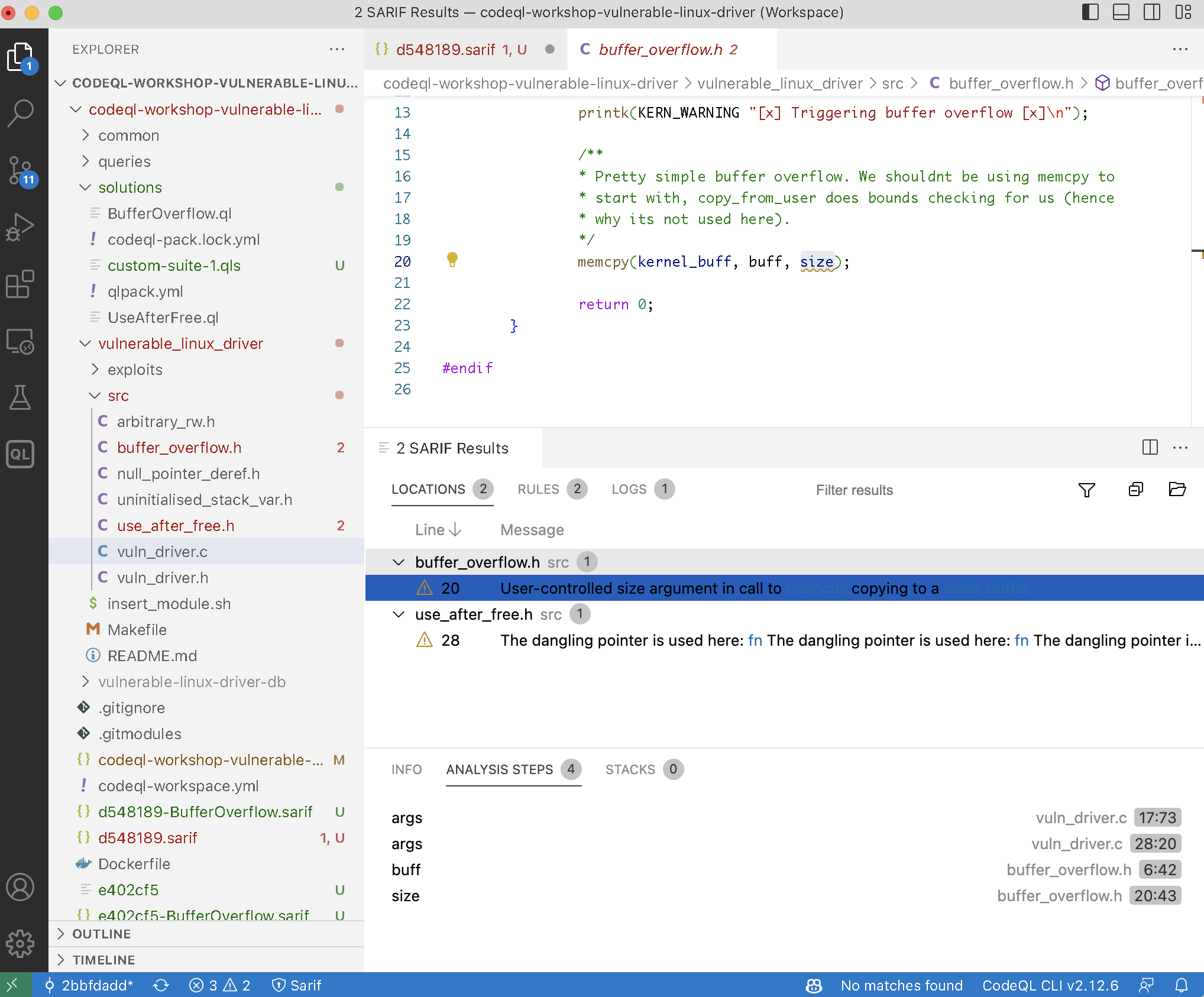
Reviewing looks as follows.
### View raw sarif with `jq`
List the SARIF files again
cd ~/local/codeql-cli-end-to-end
find . -maxdepth 2 -name "*.sarif"
./codeql-workshop-vulnerable-linux-driver/e402cf5.sarif
./codeql-workshop-vulnerable-linux-driver/d548189.sarif
./codeql-workshop-vulnerable-linux-driver/d548189-BufferOverflow.sarif
./codeql-workshop-vulnerable-linux-driver/e402cf5-UseAfterFree.sarif
./codeql-workshop-vulnerable-linux-driver/e402cf5-BufferOverflow.sarif
The CodeQL version
cd ~/local/codeql-cli-end-to-end
jq '.runs | .[0] | .tool.driver.semanticVersion ' < ./codeql-workshop-vulnerable-linux-driver/e402cf5.sarif
"2.13.4"
The names of rules processed
cd ~/local/codeql-cli-end-to-end
jq '.runs | .[] | .tool.driver.rules | .[] | .name ' < ./codeql-workshop-vulnerable-linux-driver/d548189.sarif
"cpp/buffer_overflow"
"cpp/use_after_free"
### View raw sarif with `jq` and fzf
Install the fuzzy finder
brew install fzf
or `apt-get=/=yum` on linux
Try working to `.runs[0].tool.driver.rules` and follow the output in real
time.
pushd ~/local/codeql-cli-end-to-end/codeql-workshop-vulnerable-linux-driver
res=e402cf5-UseAfterFree.sarif
echo '' | fzf --print-query --preview="jq {q} < $res"
popd
### sarif-cli
#### Setup / local install
Clone or
cd ~/local/codeql-cli-end-to-end
git clone git@github.com:hohn/sarif-cli.git
cd ~/local/codeql-cli-end-to-end/sarif-cli
python3.9 -m venv .venv
. .venv/bin/activate
python -m pip install -r requirementsDEV.txt
# Put bin/ contents into venv PATH
pip install -e .
#### Compiler-style textual output from SARIF
The sarif-cli has several script to use from the shell level:
cd ~/local/codeql-cli-end-to-end/sarif-cli
ls -1 bin/
json-to-yaml
sarif-aggregate-scans
sarif-create-aggregate-report
sarif-digest
sarif-extract-multi
sarif-extract-scans
sarif-extract-scans-runner
sarif-extract-tables
sarif-labeled
sarif-list-files
sarif-pad-aggregate
sarif-results-summary
sarif-to-dot
The simplest one just list the source files found during analysis:
. ~/local/codeql-cli-end-to-end/sarif-cli/.venv/bin/activate
cd ~/local/codeql-cli-end-to-end/codeql-workshop-vulnerable-linux-driver
sarif-list-files d548189.sarif
src/buffer_overflow.h
src/use_after_free.h
src/vuln_driver.c
Much more useful is a compiler-style summary of all results found:
. ~/local/codeql-cli-end-to-end/sarif-cli/.venv/bin/activate
cd ~/local/codeql-cli-end-to-end/codeql-workshop-vulnerable-linux-driver
sarif-results-summary d548189.sarif
RESULT: src/buffer_overflow.h:20:43:20:47: User-controlled size argument in call to [memcpy](1) copying to a [stack buffer](2)
PATH 0
FLOW STEP 0: src/vuln_driver.c:17:73:17:77: args
FLOW STEP 1: src/vuln_driver.c:28:20:28:33: args
FLOW STEP 2: src/buffer_overflow.h:6:42:6:46: buff
FLOW STEP 3: src/buffer_overflow.h:20:43:20:47: size
RESULT: src/use_after_free.h:28:11:28:25: The dangling pointer is used here: [fn](1)
The dangling pointer is used here: [fn](2)
The dangling pointer is used here: [arg](3)
The dangling pointer is used here: [fn](4)
The dangling pointer is used here: [arg](5)
This sarif file has only two results, so the output is short:
RESULT: src/buffer_overflow.h:20:43:20:47: User-controlled size argument in call to [memcpy](1) copying to a [stack buffer](2)
PATH 0
FLOW STEP 0: src/vuln_driver.c:17:73:17:77: args
FLOW STEP 1: src/vuln_driver.c:28:20:28:33: args
FLOW STEP 2: src/buffer_overflow.h:6:42:6:46: buff
FLOW STEP 3: src/buffer_overflow.h:20:43:20:47: size
RESULT: src/use_after_free.h:28:11:28:25: The dangling pointer is used here: [fn](1)
The dangling pointer is used here: [fn](2)
The dangling pointer is used here: [arg](3)
The dangling pointer is used here: [fn](4)
The dangling pointer is used here: [arg](5)
This illustrates the differences in the output between the two result `@kind`
s:
- `@kind problem` is a single list of results found
- `@kind path-problem` is a list of flow paths. Each path in turn is a list
of locations.
Most of these scripts take options that significantly change their output; to
see them, use the `-h` or `--help` flags. E.g.,
. ~/local/codeql-cli-end-to-end/sarif-cli/.venv/bin/activate
sarif-results-summary -h
usage: sarif-results-summary [-h] [-s srcroot] [-r] [-e] [-c] sarif-file
summary of results
positional arguments:
sarif-file input file, - for stdin
optional arguments:
-h, --help show this help message and exit
-s srcroot, --list-source srcroot
list source snippets using srcroot as sarif SRCROOT
-r, --related-locations
list related locations like "hides [parameter](1)"
-e, --endpoints-only only list source and sink, dropping the path.
Identical, successive source/sink pairs are combined
-c, --csv output csv instead of human-readable summary
Some of these make output much more informative, like `-r` and `-s`:
With `-r`:
. ~/local/codeql-cli-end-to-end/sarif-cli/.venv/bin/activate
cd ~/local/codeql-cli-end-to-end/codeql-workshop-vulnerable-linux-driver
sarif-results-summary -r d548189.sarif
RESULT: src/buffer_overflow.h:20:43:20:47: User-controlled size argument in call to [memcpy](1) copying to a [stack buffer](2)
REFERENCE: src/buffer_overflow.h:20:17:20:23: memcpy
REFERENCE: src/buffer_overflow.h:8:22:8:33: stack buffer
PATH 0
FLOW STEP 0: src/vuln_driver.c:17:73:17:77: args
FLOW STEP 1: src/vuln_driver.c:28:20:28:33: args
FLOW STEP 2: src/buffer_overflow.h:6:42:6:46: buff
FLOW STEP 3: src/buffer_overflow.h:20:43:20:47: size
RESULT: src/use_after_free.h:28:11:28:25: The dangling pointer is used here: [fn](1)
The dangling pointer is used here: [fn](2)
The dangling pointer is used here: [arg](3)
The dangling pointer is used here: [fn](4)
The dangling pointer is used here: [arg](5)
REFERENCE: src/use_after_free.h:84:22:84:24: fn
REFERENCE: src/use_after_free.h:87:70:87:72: fn
REFERENCE: src/use_after_free.h:87:90:87:93: arg
REFERENCE: src/use_after_free.h:89:20:89:22: fn
REFERENCE: src/use_after_free.h:89:39:89:42: arg
If the source code is available, we can use `-s` to include snippets in the
output. This effectively converts sarif to the format used by gcc and clang
to report warnings and errors.
. ~/local/codeql-cli-end-to-end/sarif-cli/.venv/bin/activate
cd ~/local/codeql-cli-end-to-end/codeql-workshop-vulnerable-linux-driver
sarif-results-summary -s vulnerable_linux_driver/ d548189.sarif
RESULT: src/buffer_overflow.h:20:43:20:47: User-controlled size argument in call to [memcpy](1) copying to a [stack buffer](2)
memcpy(kernel_buff, buff, size);
^^^^
PATH 0
FLOW STEP 0: src/vuln_driver.c:17:73:17:77: args
static long do_ioctl(struct file *filp, unsigned int cmd, unsigned long args)
^^^^
FLOW STEP 1: src/vuln_driver.c:28:20:28:33: args
buffer_overflow((char *) args);
^^^^^^^^^^^^^
FLOW STEP 2: src/buffer_overflow.h:6:42:6:46: buff
static int buffer_overflow(char __user *buff)
^^^^
FLOW STEP 3: src/buffer_overflow.h:20:43:20:47: size
memcpy(kernel_buff, buff, size);
^^^^
RESULT: src/use_after_free.h:28:11:28:25: The dangling pointer is used here: [fn](1)
The dangling pointer is used here: [fn](2)
The dangling pointer is used here: [arg](3)
The dangling pointer is used here: [fn](4)
The dangling pointer is used here: [arg](5)
uaf_obj *global_uaf_obj = NULL;
^^^^^^^^^^^^^^
#### SQL conversion – not compatible with codeql v2.13.4
The ultimate purpose of the sarif-cli is producing CSV files for import into
SQL databases. This requires a completely defined static structure, without
any optional fields. The internals of the tool are beyond the scope of this
workshop, some details are their external effects are important:
1. a (very large and comprehensive) type signature is defined in sarif-cli
2. sarif files that have extra fields not in the signature will produce warnings
3. sarif files that are missing fields from the signature will produce a fatal
error. A message will be printed and the scripts will abort.
4. Sometimes, sarif files will have a field but no content. For a number of
these, dummy values are inserted. One example are queries that don't
produce line numbers in their output; for those, -1 is used as value.
Unfortunately, this version of codeql
cd ~/local/codeql-cli-end-to-end
./codeql/codeql --version
CodeQL command-line toolchain release 2.13.4.
Copyright (C) 2019-2023 GitHub, Inc.
Unpacked in: /Users/hohn/local/codeql-cli-end-to-end/codeql
Analysis results depend critically on separately distributed query and
extractor modules. To list modules that are visible to the toolchain,
use 'codeql resolve qlpacks' and 'codeql resolve languages'.
has signature changes incompatible with (the older) sarif-cli (version
e62c351)
## Running sequence
### Smallest query suite to largest
A short script to show us how many queries the standard suites have:
export PATH=$HOME/local/codeql-cli-end-to-end/codeql:"$PATH"
queries=`codeql resolve queries 2>&1 | grep cpp | awk '{print($1)}'`
(
for suite in $queries
do
len=`codeql resolve queries $suite | wc -l`
echo "Suite $suite has $len queries"
done
) 2>/dev/null
Suite cpp-code-scanning.qls has 47 queries
Suite cpp-lgtm-full.qls has 169 queries
Suite cpp-lgtm.qls has 100 queries
Suite cpp-security-and-quality.qls has 167 queries
Suite cpp-security-experimental.qls has 118 queries
Suite cpp-security-extended.qls has 83 queries
If we want to gradually increase coverage using the standard suites, we would
thus use them in this order:
- cpp-code-scanning.qls, 47 queries
- cpp-security-extended.qls, 83 queries
- cpp-lgtm.qls, 100 queries
- cpp-security-experimental.qls, 118 queries
- cpp-security-and-quality.qls, 167 queries
- cpp-lgtm-full.qls, 169 queries
### Working with results based on counts
- Lots of result (> 5000)
Use the [sarif-cli](#org08832bc), e.g., `sarif-results-summary -r d548189.sarif`, as above.
- Medium result sets (~ 2000 results)
Use the [sarif-cli](#org08832bc) or try the [SARIF viewer plugin](#org1dd7344).
- Few results
Use the [SARIF viewer plugin](#org1dd7344) for detailed review and working with the results
/ queries. Use the [sarif-cli](#org08832bc) for quick command-line comparison.
## Comparing analysis results across sarif files
Use the [sarif-cli](#org08832bc).
Options:
- use `sarif-results-summary` on each sarif result file individually, then
compare the resulting text files via `diff`-style tools
- (powerful, but effort required) if your version of CodeQL is compatible, use
`sarif-extract-scans-runner` to put all results into an SQL database and use
that to query the results.
## Miscellany
- Scale factor for building DBs: Common case: 15 minutes for a parallel cpp
compilation can be a 2 hour database build for codeql.